


Polymer Coatings
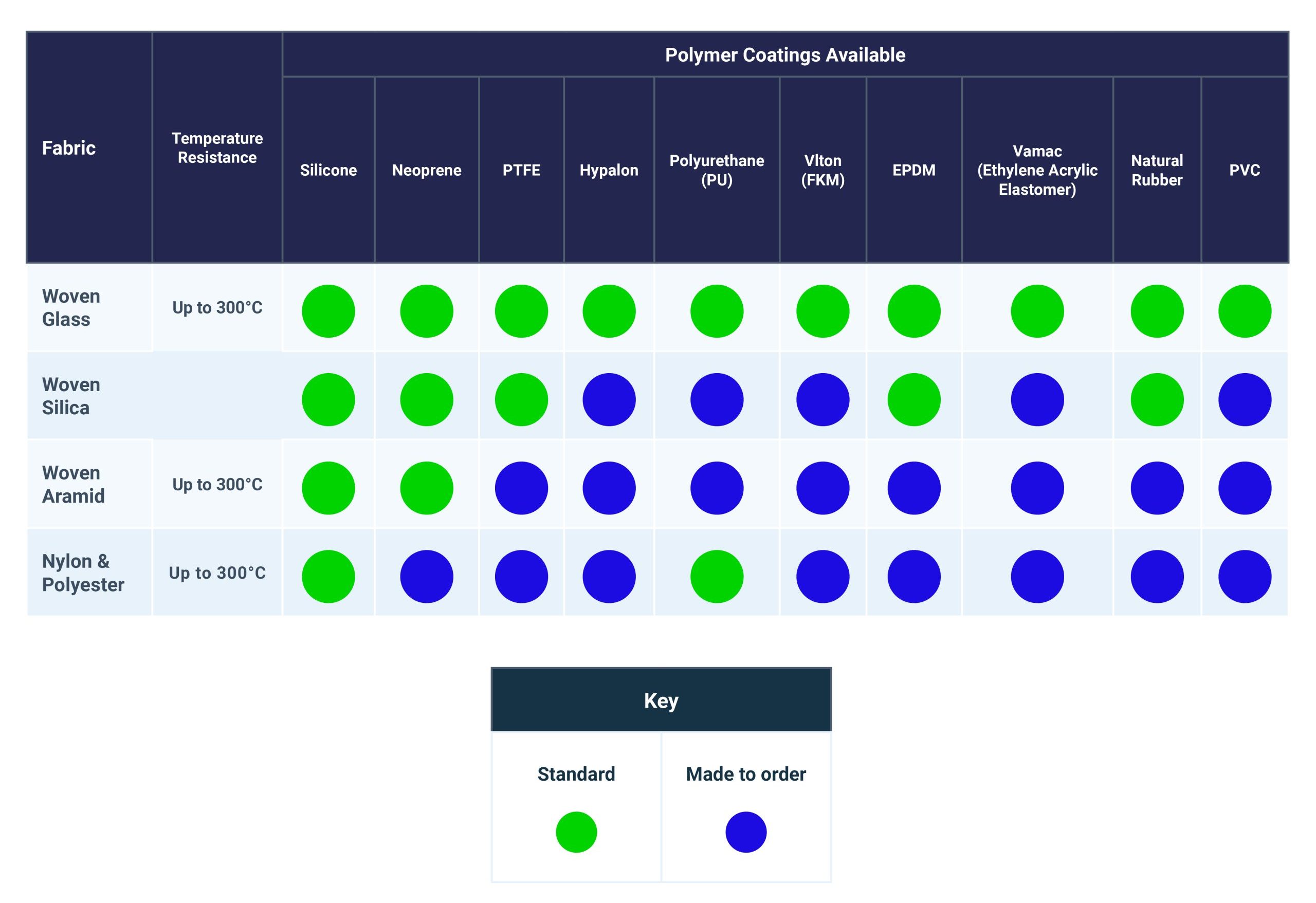
Polymer coated on fabrics can be made with a near endless number of combinations, from one or both sides coated, with anything from 30g/m2 to 2000g/m2+ coat weight in nearly any colour required, it’s even possible to have one polymer on one side and another polymer on the other side.
Most rubbers and polymers can be converted into a form which can then be coated onto a textile, these polymers and rubber coatings give the fabric new properties and resistances, and these include:
| Resistances | Properties |
|
|
Silicone
Excellent resistance to weather and UV, high temperature resistance, easily cleaned, can be produced with Anti-static, conductive or acid/alkali indicating properties.
Applications include: insulation jackets and mattresses, fire blankets, welding blankets, flexible connectors and compensators, hosing and ducting, protective covers, abrasion and pierce/cut resistant covers.
Neoprene®
Good abrasion resistance, good resistance to weathering in general, can be produced with Anti-static or conductive properties. Applications include: flexible connectors and bellows, hosing and ducting, welding blankets, pierce-resistant covers.
PTFE
Excellent resistance to most chemicals, weathering and UV, high temperature resistance, easily cleaned.
Applications include: insulation jackets and mattresses (thermal insulation), chemical protection, food contact, industrial belting, flexible connectors and compensators, cryogenic application.
Hypalon®
Extremely good resistance to most acids, alkalis, alcohols, liquids and weathering. Applications include: flexible connectors and compensators, hosing and ducting, chemical protection.
Polyurethane (PU)
On its own PU is an economical treatment used to stabilise fabrics and prevent fraying, but with the addition of additives the coatings help fabrics retain integrity as fire and smoke curtains.
Viton®(FKM)
Extremely good resistance to fuels and oils and can be used for flexible connectors, hosing and ducting, protective covers.
EPDM
Specific chemical resistance.
Vamac® (Ethylene Acrylic Elastomer)
Excellent weathering and UV resistance, low smoke, no halogen compound, can be produced with Anti-Static properties. Applications include insulation jackets and mattresses, outdoor covers, radiant heat screening, flexible connectors.
Natural Rubber
Temperature resistance – once in place as a seal or gasket 240°c, otherwise 120°c
Self curing once in place as a seal or gasket, suitable for pressure up to 25 bar. Natural rubber can be used for sealing and gaskets
PVC
Durable, flexible, phthalate free. Applications include hosing and ducting. Applications include hosing and ducting.
With the exception of the natural rubber proofed glass, the above is supplied as standard in a fully cured or vulcanised state. It is possible to produce some of these polymers as uncured or unvulcanised, or even in a partially vulcanised state.
Coating Techniques
With the exception of the natural rubber proofed glass, the above is supplied as standard in a fully cured or vulcanised state. It is possible to produce some of these polymers as uncured or unvulcanised, or even in a partially vulcanised state.
THS utilise a number of different coating techniques and methods to produce the range of coated textiles, these include:
- Knife Coating (knife over air, and knife over roller)
- Friction Coating
- Calendar Coating
- Dip Coating
Can't find what you are looking for? THS Textiles offers bespoke products for a range of different applications. Get in touch with us to discuss your specific requirement.
